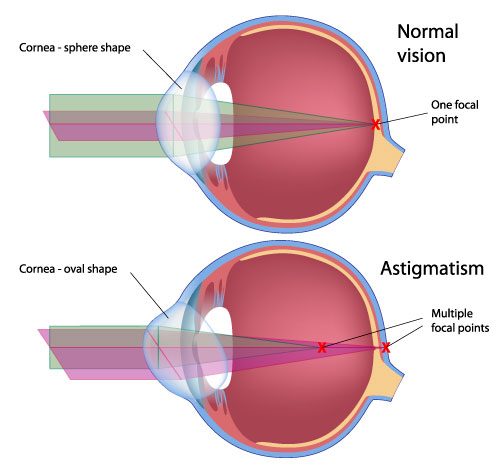
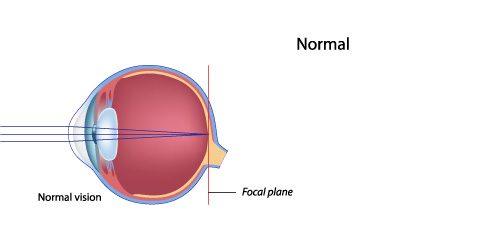
In the normal eye, light rays pass through the cornea, pupil, and lens and focus directly on the retina. When the cornea fails to focus light rays directly on the retina, refractive errors such as myopia, hyperopia, and astigmatism occur.
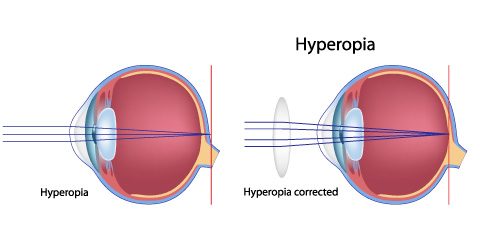
Hyperopia
Hyperopia, or farsightedness, occurs when the curvature of the cornea is too flat or the eyeball is too short. Therefore, light rays entering the eye focus in back of the retina. This results in blurred near vision.
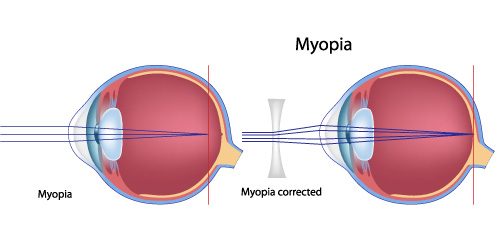
Myopia
Myopia, or nearsightedness, occurs when the curvature of the cornea is too steep or the eyeball is too long. Therefore, light rays entering the eye focus in front of the retina. This results in blurred vision at distance.
Astigmatism
Astigmatism occurs when the curvature of the cornea is irregularly shaped, almost like a football. Therefore, light rays entering the eye focus at two different foci, causing blurred or distorted vision at a distance and up close. Astigmatism can occur alone or in conjunction with myopia and hyperopia.
Presbyopia
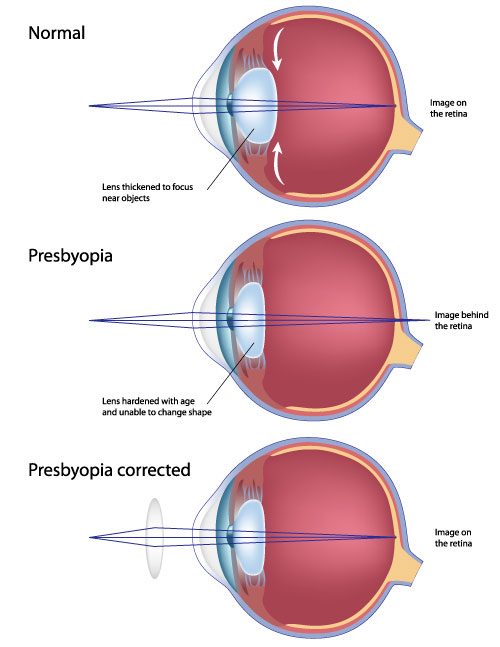
Presbyopia is a condition where the crystalline lens loses its flexibility or elasticity, making it difficult to focus on nearby objects. Generally, presbyopia becomes noticeable in the early to mid-40s. Presbyopia is an unpreventable, age-related process. To help alleviate symptoms of presbyopia, reading glasses, bifocals, progressive lenses, and multi-focal contact lenses can be prescribed.